
How to Choose a Robot for University Projects

Matt Wilton
Director

Table of contents
Share
A university can buy a robot that students programme on the first afternoon, then discover six months later that it cannot carry the planned camera and gripper or expose the required controls through ROS. The opposite mistake is specifying an industrial arm for a light desktop exercise.
A robot for university projects has to suit the work around it. That may be one researcher collecting tactile data, a mechatronics student integrating a PLC, or several groups sharing a laboratory. Software, tooling and safety determine what can actually be built.
The useful question is not which cobot has the longest specification sheet. It is which platform supports the first exercise without closing off the next project.
What do you want students or researchers to build?
Define the finished project before choosing the robot. One example might be a system that identifies a randomly positioned component, picks it without damage, places it into a fixture and sends the result to a PLC.
That project requires six-axis movement, a suitable gripper, machine vision and an interface to the wider control system. A tactile manipulation project has different priorities, such as force control, GelSight data and precise contact information. Embodied-AI research may place greater emphasis on data capture, external software control and access to camera and joint data.
Start with the most demanding project the robot is expected to support. A platform selected for a simple teaching exercise may become restrictive as soon as students add vision, heavier tooling or external control.
Which robot specifications should you compare?
Start with payload and reach, but calculate both against the complete application.
The payload is the combined mass of the component, gripper, fingers, camera, mounting brackets and cables carried by the arm. Tool length and centre of gravity must also be checked. A long camera or gripper assembly can exceed the permitted wrist load even when its total mass is within the headline payload.
Reach should be assessed across the required movement, not measured only between the robot base and the furthest point. Check the pick position, placement position, tool orientation and clearance around fixtures. The robot must reach each point without repeatedly approaching a joint limit or awkward wrist configuration.
Repeatability tells you how consistently the robot returns to a programmed position. It does not describe absolute accuracy, and it cannot compensate for a flexible fixture or poor camera calibration. For vision-guided work, the relationship between the camera, tool and robot coordinate systems may have greater influence on the final result.
Finally, account for the controller, power supply, emergency-stop circuit and external services. Camera cables, pneumatic hoses and gripper wiring must move with the arm without restricting a joint, snagging on the bench or failing under repeated flexing.
How easy should the robot be to programme and extend?
Beginners need a low barrier to first motion. Researchers need access beyond it.
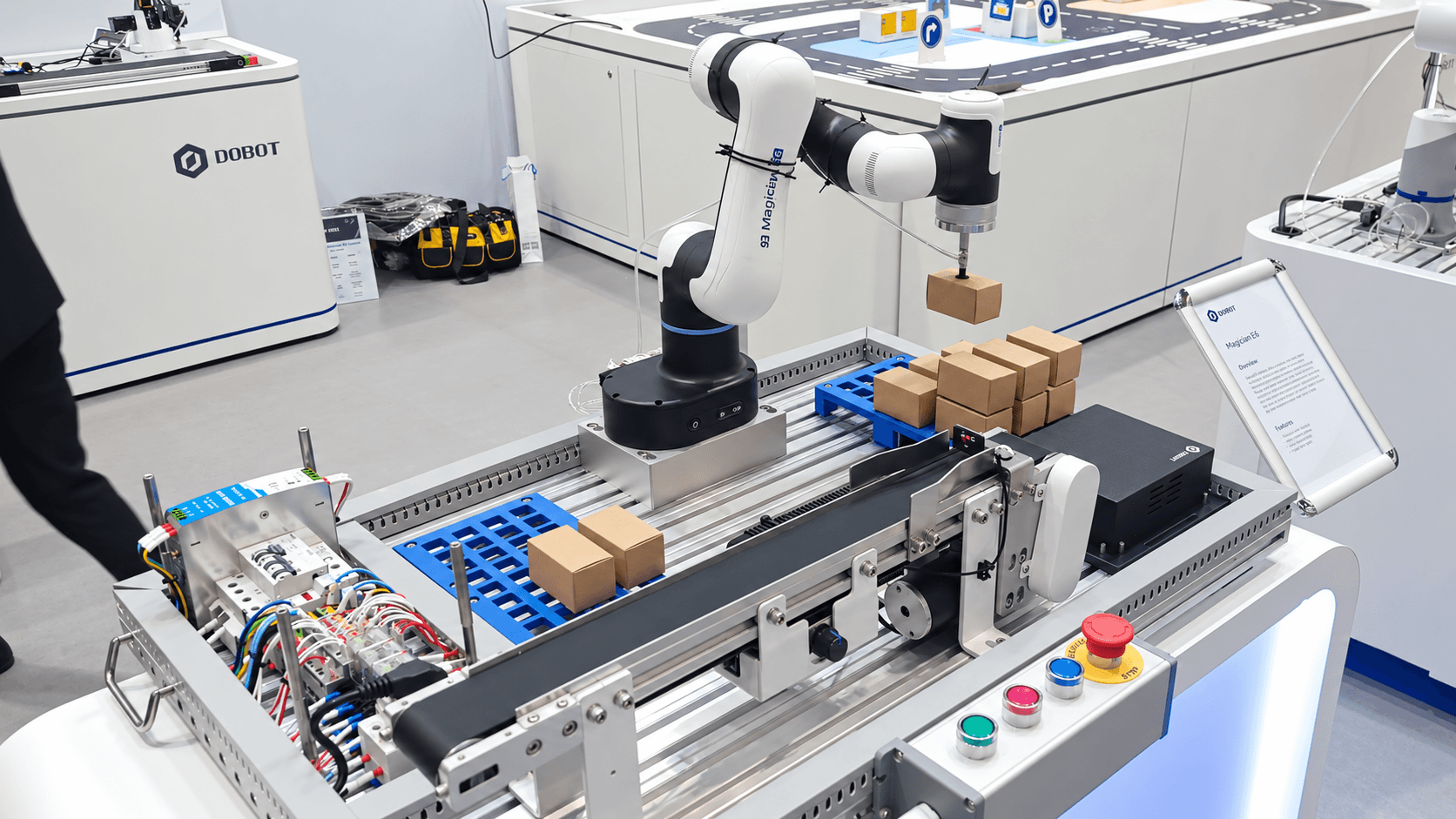
DOBOT Magician E6 combines graphical and hand-guided teaching with ROS, MATLAB, LabVIEW, Python and C++. It suits students learning frames, waypoints and six-axis kinematics.
DOBOT CRA uses DobotStudio Pro for graphical programming, Lua, offline simulation and breakpoint debugging. External development supports C++, C#, Python, ROS 1 and ROS 2. Its controller provides 24 digital inputs, 24 outputs, Modbus TCP/RTU, EtherNet/IP and PROFINET, making CR3A and CR5A strong bases for PLC, vision or custom-software projects.
Do not accept “ROS compatible” as the whole answer. Confirm that the driver exposes the commands, state data and update rate required by the experiment.
Which robot for university projects fits the work?
For serious mechatronics and research projects, I would start with CR3A or CR5A. Magician E6 is the better fit for compact six-axis teaching.
Platform | Key specification | Choose it when | Move elsewhere when |
|---|---|---|---|
Magician E6 | 0.75 kg payload, 450 mm reach, ±0.1 mm repeatability | Students need an accessible six-axis desktop arm for motion, programming or light vision exercises | The tool package includes a substantial gripper, wrist camera or process load |
Nova 2 / Nova 5 | 2 kg / 5 kg payload, 625 mm / 850 mm reach, ±0.05 mm repeatability | Low mass and a compact arm are defined requirements | Industrial-cell teaching is central to the brief |
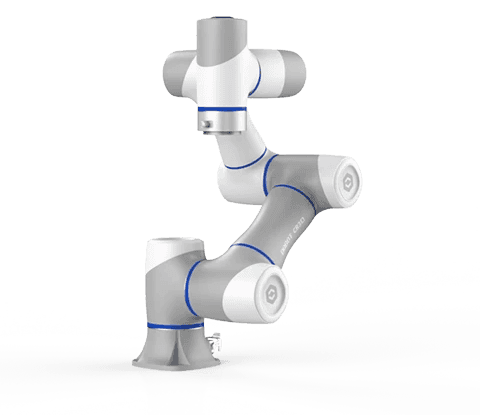
CR3A | 3 kg payload, 620 mm reach, ±0.02 mm repeatability | Research needs industrial control, open software and useful tooling capacity | The layout needs more reach or the wrist load approaches 3 kg |
CR5A | 5 kg payload, 900 mm reach, ±0.02 mm repeatability | A larger bench or tool package needs the extra capacity | The project is a light desktop exercise |
CRAS / CRAF | SafeSkin proximity sensing or integrated six-axis force sensing | Proximity or controlled-contact research defines the project | A standard CRA plus external sensor meets the requirement |
MG400 | Four-axis desktop robot | The task is planar pick-and-place or a compact production-style demonstration | The curriculum requires six-axis kinematics or arbitrary tool orientation |
CR3A is my default starting point. CR5A earns its place when 900 mm reach improves the layout or the wrist assembly needs its extra capacity. Otherwise it consumes bench space and budget without improving the experiment.
Which accessories make the robot useful?
A robot arm positions a tool. The accessory choice creates the application.
An electric parallel gripper provides programmable position and force. Vacuum suits flat, non-porous parts. Pneumatic tooling offers high force for its mass, but introduces air control and hose routing. Finger design still determines grip reliability.
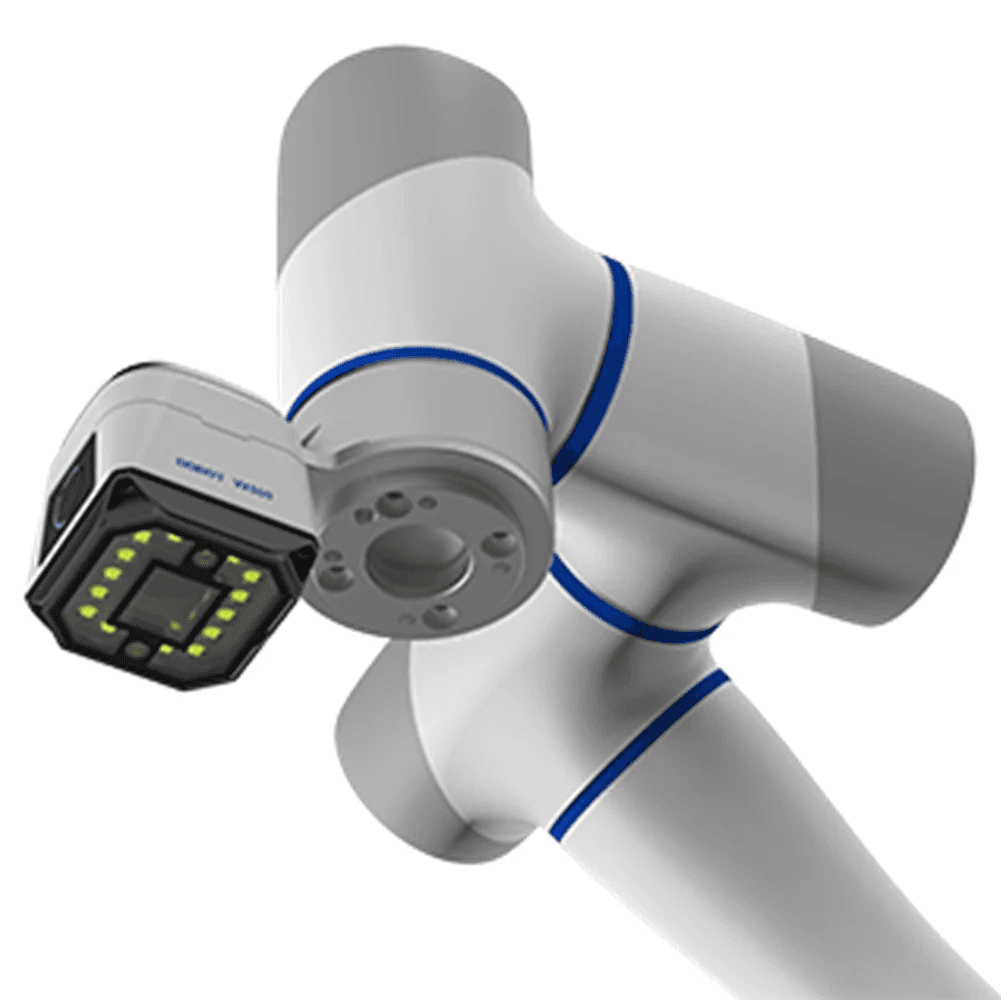
A wrist-mounted DOBOT VX500 handles positioning, presence checks, barcode reading, OCR and dimensional inspection, with ±0.26 mm positioning repeatability under its defined test condition. AIET Group can instead integrate a HIKROBOT machine-vision system around the required field of view, working distance and feature size.
Force-controlled CRA models suit insertion and other contact work. A GelSight tactile sensor adds surface and contact information for slip detection or grasp research. They are not interchangeable.
Does AI belong in the project?
AI belongs where research depends on learned behaviour or data collection. Adding a camera to programmed pick-and-place does not create an AI system.
CRA provides a physical platform using ROS or Python, with vision, force or tactile data added to suit the study. Model training and inference remain separate work.
DOBOT X-Trainer addresses embodied-AI work needing dual-arm teleoperation and recorded demonstrations. Its SDK covers data collection, training and inference, with access to joint angles, gripper control and RGB/depth data. Bristol Robotics Laboratory has progressed from DOBOT tactile manipulation platforms to X-Trainer research.
What should a university robotics bench include?
AIET Group can build a CR3A or CR5A bench with an electric gripper, interchangeable fingers and part fixtures. Add a robot-mounted VX500 or HIKROBOT camera where parts are not mechanically located.
A PLC and HMI make the station an automation project. Overhead light guidance can direct loading or inspection. Add GelSight Mini where contact data is required.
Specify secure cable routing, accessible isolation, replaceable tooling, user permissions and a known reset routine.
Several compact stations may suit a shared laboratory; one CR5A may suit long research experiments. Expected utilisation should decide the quantity.
Why are universities choosing DOBOT?
DOBOT covers six-axis teaching, industrial research and dedicated AI data collection. A department can retain common programming concepts across different physical capabilities.
Affordability is useful only if the required interfaces and mechanical capacity remain. CRA undergoes more than 200 performance and quality tests, has certified mean time between failures of 120,000 hours and currently carries a three-year warranty. That is a credible case beyond demonstration benches.
Existing work includes Magician E6 teaching at Essex, tactile robotics at Edinburgh and Bristol, automation at Heriot-Watt, and remote laboratory access at Complutense University of Madrid.
How do you make a university robot usable and safe?
A collaborative robot is not automatically a safe application. ISO 10218-1:2025 covers the robot, while ISO 10218-2:2025 covers the application and cell. ISO/TS 15066:2016 provides guidance for collaborative operation.
Risk assessment includes the gripper, workpiece and fixture. A low-force arm carrying sharp metal can still cut; a pneumatic gripper can crush after robot motion stops. Assess access, trapping, speed, stopping and foreseeable misuse. Guarding, scanners or restricted modes may remain necessary.
CRA provides configurable safety zones, five collision-sensitivity levels and dual-channel safety I/O. CRAS adds SafeSkin detection up to 150 mm. Neither removes the need to assess the station.
Before asking AIET Group to specify the system, prepare:
Teaching outcome or research question
Heaviest part and end effector
Accuracy, repeatability
Programming environment and external equipment
Users, access and planned extensions
How AIET helps
AIET Group specifies the complete application for universities and innovation centres in the UAE, GCC and wider Middle East. Work can include DOBOT selection, tooling, vision trials, PLC integration, a customised bench and commissioning.
AIET Group assesses tooling hazards, access, speed, stopping behaviour and required safeguards. Training can then use the installed hardware and the department's own exercises.
Speak to AIET Group
Send a bench drawing, representative sample, tolerance, cycle time and photographs. Include the intended software, user access and any selected camera, gripper or sensor.
Speak to AIET Group about a university robotics system. AIET Group will identify what needs testing and whether CR3A, CR5A or a smaller platform is appropriate.
FAQ
Which DOBOT is best for a university robotics laboratory?
CR3A is the strongest general starting point for a serious university laboratory. Its 3 kg payload, 620 mm reach, ±0.02 mm repeatability and industrial controller support mechatronics integration without requiring a large cell. Choose Magician E6 for compact introductory teaching, or CR5A where 900 mm reach and 5 kg capacity solve a defined need.
Is Magician E6 suitable for university research?
Yes, Magician E6 suits research that stays within its 0.75 kg payload and 450 mm reach. It supports ROS, MATLAB, LabVIEW, Python and C++, so it is capable of more than graphical teaching. Move to CRA when the project needs heavier tooling, industrial communication protocols or tighter published repeatability.
Can DOBOT robots be programmed with ROS and Python?
Yes, DOBOT provides ROS and Python routes across the relevant education and collaborative-robot platforms. Magician E6 also supports MATLAB, LabVIEW and C++. CRA supports ROS 1, ROS 2, Python, C++ and C#, while DobotStudio Pro provides graphical programming and Lua for users who do not need external control.
Do collaborative robots need safety guarding in a university?
Sometimes. The decision depends on the complete application, including the tool, component, speed and access. A rounded gripper moving a plastic block presents a different hazard from a sharp workpiece or pneumatic clamp. A documented risk assessment may justify collaborative operation, reduced-speed zones, a scanner or physical guarding.
Can a DOBOT robot use machine vision?
Yes, DOBOT robots can use fixed or wrist-mounted machine vision. VX500 provides image acquisition, processing, lighting and lens calibration in one system. AIET Group can also integrate HIKROBOT cameras with selected optics and illumination. The correct arrangement depends on field of view, working distance, feature size and required result.
What is the difference between cobot automation and embodied-AI research?
Programmed automation repeats a defined sequence, while embodied-AI research records interaction data and trains a model to handle variation. A CRA robot can support custom perception or learning experiments through ROS and external sensors. X-Trainer is designed specifically for dual-arm teleoperation, demonstration capture, model training and inference.
Can AIET build a complete university robotics bench?
Yes, AIET Group can configure a bench around CR3A or CR5A with a gripper, fixtures and machine vision. Options include PLC and HMI control, a robot-mounted camera, overhead light-guided instructions and GelSight tactile sensing. The final safeguarding and access arrangement follows the risk assessment for the planned exercises.


