Five Things to Get Right Before Buying Machine Vision

Matt Wilton
Director

Table of contents
Share
Before You Buy a Machine Vision System: Five Questions UAE Manufacturers Should Answer
Machine vision is often presented as a camera-selection problem.
It usually is not.
By the time someone starts comparing camera resolution, processor speed and AI features, several more important decisions should already have been made. What exactly must be inspected? What variation is acceptable? How will the part be presented? What happens when something fails?
Cognex recently set out five areas manufacturers should consider before beginning a machine vision project: application requirements, operating environment, scalability, image formation and total cost of ownership. It is a useful framework. The difficult part is turning those headings into a system that still works after six months on a production line.
Based on the projects we see across the UAE and GCC, these are the points worth resolving early.
Start with the decision, not the camera
“Inspect the product” is not a usable specification.
The first question is what decision the system must make. That might be:
Is the component present?
Is the print complete and legible?
Is the connector fitted correctly?
Is a surface defect larger than the permitted limit?
Is the product within dimensional tolerance?
Does the code match the current batch?
Those are different problems and may require completely different imaging methods.
The acceptance criteria also need to be clear. A scratch may be acceptable at 0.2 mm but not at 0.5 mm. A moulding mark may look like a defect but be entirely normal. Print contrast may vary between suppliers without affecting readability.
This is why representative samples matter. A few perfect components and two obvious failures prove very little. A proper feasibility study needs normal production variation, borderline parts and examples from different batches, machines or suppliers.
The most useful starting point is usually a box of parts and a direct conversation with quality, production and engineering.
AIET supports machine vision feasibility studies and inspection system development for manufacturers across the UAE and GCC.
The factory will expose every weak assumption
A vision system can work perfectly on a desk and fail within hours on a line.
In this region, temperature, dust and changing ambient light deserve more attention than they often receive. Loading-bay doors open. Sunlight moves during the day. Air-conditioning creates sharp temperature changes. Fine dust settles on lenses, lights and protective windows.
There may also be vibration from conveyors, presses or nearby machinery. Oil mist, coolant and cleaning chemicals can gradually reduce image quality. Reflective products may look completely different depending on their orientation or surface condition.
None of this is unusual. It simply needs to be designed for.
Where possible, the inspection area should be optically controlled rather than left exposed to factory lighting. Enclosures, shielding, filters and strobed illumination are often more important than adding more megapixels.
The mechanical arrangement matters as well. A camera cannot compensate for a part that moves unpredictably, changes height or arrives at a different angle on every cycle.
Do not design a dead end
A system may begin with one product and one inspection point. That does not mean it will stay that way.
Before selecting the hardware, it is worth asking:
Are more variants likely?
Could another inspection be added later?
Will the same system be copied onto other lines?
Who will manage recipe changes?
Will images or results need to be stored centrally?
Is there enough processing capacity for future tools?
A smart camera may be the correct answer for a compact, well-defined application. Cognex In-Sight systems are widely used for exactly this reason. They combine imaging, processing, industrial communications and inspection tools in one device.
For larger applications, a PC-based architecture may make more sense. Multi-camera inspection, high-resolution surface analysis and demanding AI models can quickly exceed the practical limits of an embedded platform.
There is no universally superior architecture. The right choice depends on the inspection, production environment and future plans.
Image quality decides whether the software has a chance
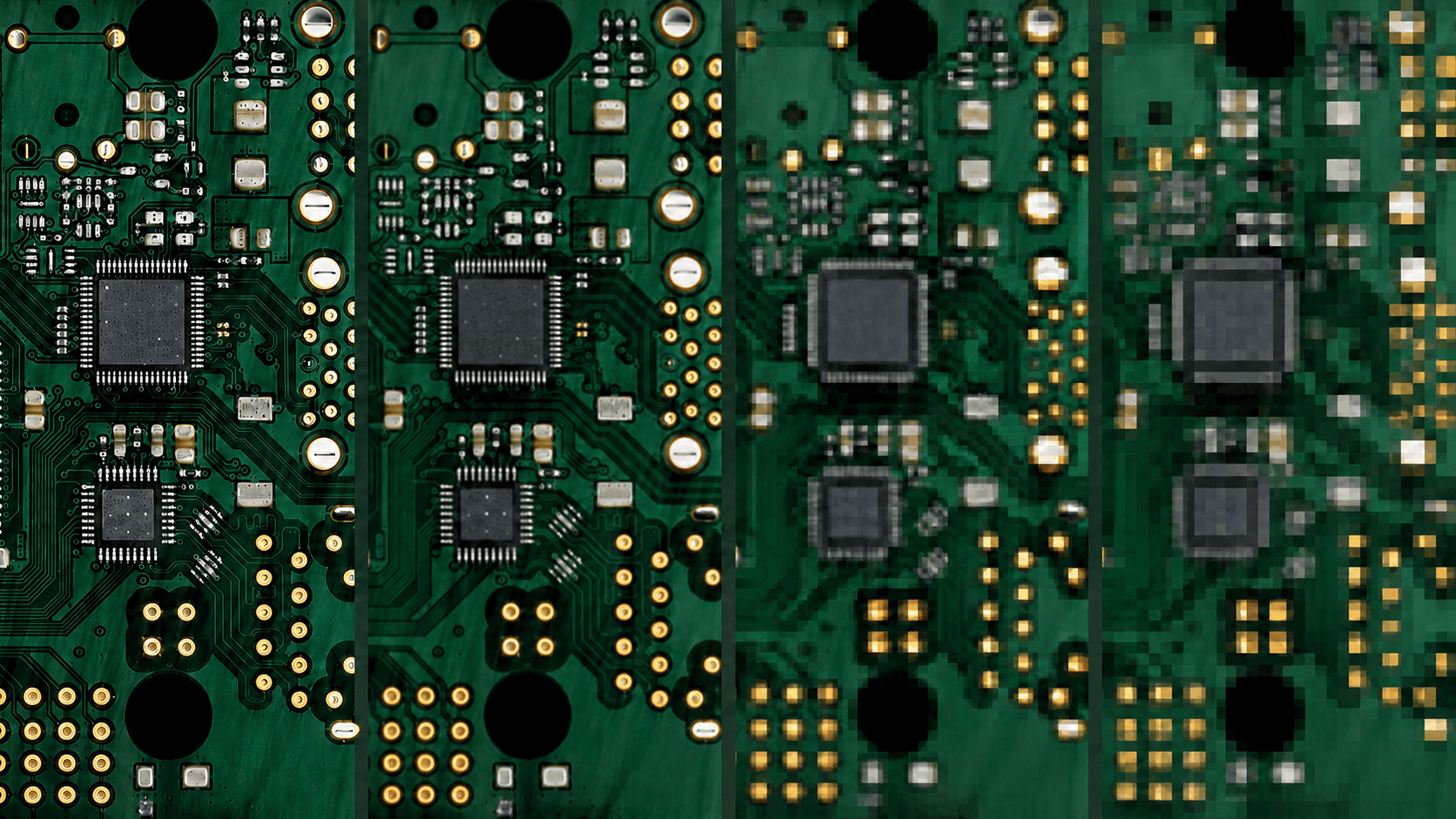
Most difficult vision applications are solved through optics and lighting before they are solved through software.
The camera needs to see the feature clearly and consistently. That sounds obvious, but it is where many projects go wrong.
Resolution is only one factor. The design also needs to account for:
Field of view
Working distance
Depth of field
Part movement
Exposure time
Lens distortion
Surface reflectivity
Required processing time
The type of camera matters too.
Area-scan systems suit most discrete components. Line-scan systems are more appropriate for continuous material, long products or cylindrical surfaces. 3D vision is useful where the inspection depends on height, depth, volume or shape rather than colour or contrast.
The choice between conventional vision and AI should also be made carefully.
Rule-based tools remain the best option for many presence, position, measurement and code-reading applications. They are predictable and easier to validate.
AI becomes useful when acceptable appearance is difficult to describe with fixed rules. Surface inspection is a common example, particularly where texture and natural variation make conventional thresholds unreliable.
But AI does not rescue poor imaging. It normally makes the weaknesses less obvious until the system reaches production.
For dimensional inspection or surface measurement, a dedicated optical metrology solution may be more appropriate than a standard machine vision camera.
Calculate the cost of failure, not only the equipment cost
Machine vision systems are often compared on initial purchase price.
That is rarely the most important number.
The real calculation should include scrap, rework, customer escapes, labour, downtime, changeover time and the cost of maintaining the system over several years.
False rejects also need to be included. Rejecting good product may protect quality, but it can destroy yield and create unnecessary manual reinspection.
The strongest business cases often come from preventing expensive failures rather than removing an operator. A relatively modest inspection system can justify itself quickly if it prevents a rejected shipment, a production stoppage or repeated customer complaints.
There is also value in the data. A well-designed system can show whether defects are linked to a particular machine, cavity, shift, supplier or batch. That allows the process to be corrected rather than simply sorting bad product at the end.
What to prepare before requesting a proposal
A supplier can give a more useful answer when the initial information is good.
Before starting discussions, gather:
Good, defective and borderline samples
A clear description of each defect or feature
Product dimensions and expected variation
Required cycle time
Photographs or video of the inspection point
Available space and working distance
Details of the PLC, conveyor or reject mechanism
Reporting and traceability requirements
Expected future product variants
This does not need to be a formal specification. It simply needs to describe the real production problem.
Machine vision support in the UAE and GCC
AIET Group supports machine vision projects across Dubai, Abu Dhabi, Sharjah and the wider GCC.
Our work includes feasibility testing, Cognex system integration, optical and lighting design, 2D and 3D inspection, AI vision, production-line integration, reporting and lifecycle support.
The objective is not to sell the largest camera or the most complicated software. It is to build an inspection system that works reliably on the line, with the product variation and environmental conditions that exist in practice.
Discuss a machine vision application with AIET
FAQ
What is a machine vision feasibility study?
A feasibility study tests whether the required feature or defect can be detected reliably before the full system is designed. It normally covers samples, lighting, optics, resolution, processing methods and cycle time.
Can Cognex systems be fitted to an existing production line?
Yes. Cognex cameras and barcode readers can be integrated with existing PLCs, conveyors, robots and reject mechanisms. The installation space, timing, communications and product presentation need to be reviewed first.
Should we use AI or conventional machine vision?
Conventional tools are usually better for measurement, position, presence and clearly defined defects. AI is more useful where appearance varies and the defect cannot easily be described using fixed rules.
Does AIET support projects outside Dubai?
Yes. AIET supports machine vision and automated inspection projects throughout the UAE and across the wider GCC.